Visual Bounty began as a place to gather work.
At first, it was simply a way to present and sell digital images. Art and design collected in one location, available as files. Over time, that model began to feel partial. The ways images were being made, sold, and used elsewhere did not quite align. Finished prints were often separated from the original file. Digital marketplaces emphasized volume over distinction. Editing tools existed independently, removed from the work they were meant to shape.
What was missing was continuity.
Visual Bounty developed through several iterations as a response to that absence, bringing the work, the process around it, and its eventual form back into relation.
The Work
The collection is the foundation.
It includes artwork, photography, textures, and compositions selected with a clear point of view. The emphasis is not on breadth alone, but on images that hold attention. Work with structure, clarity, and a sense of authorship that remains intact even when viewed out of context.
Some of these images are complete pieces. They are not provisional or awaiting treatment. They can be selected and produced as they are, including as giclée prints, with attention given to how the work translates into material form. Color, surface, and scale are handled with care and oversight.
In these instances, the act is one of selection.
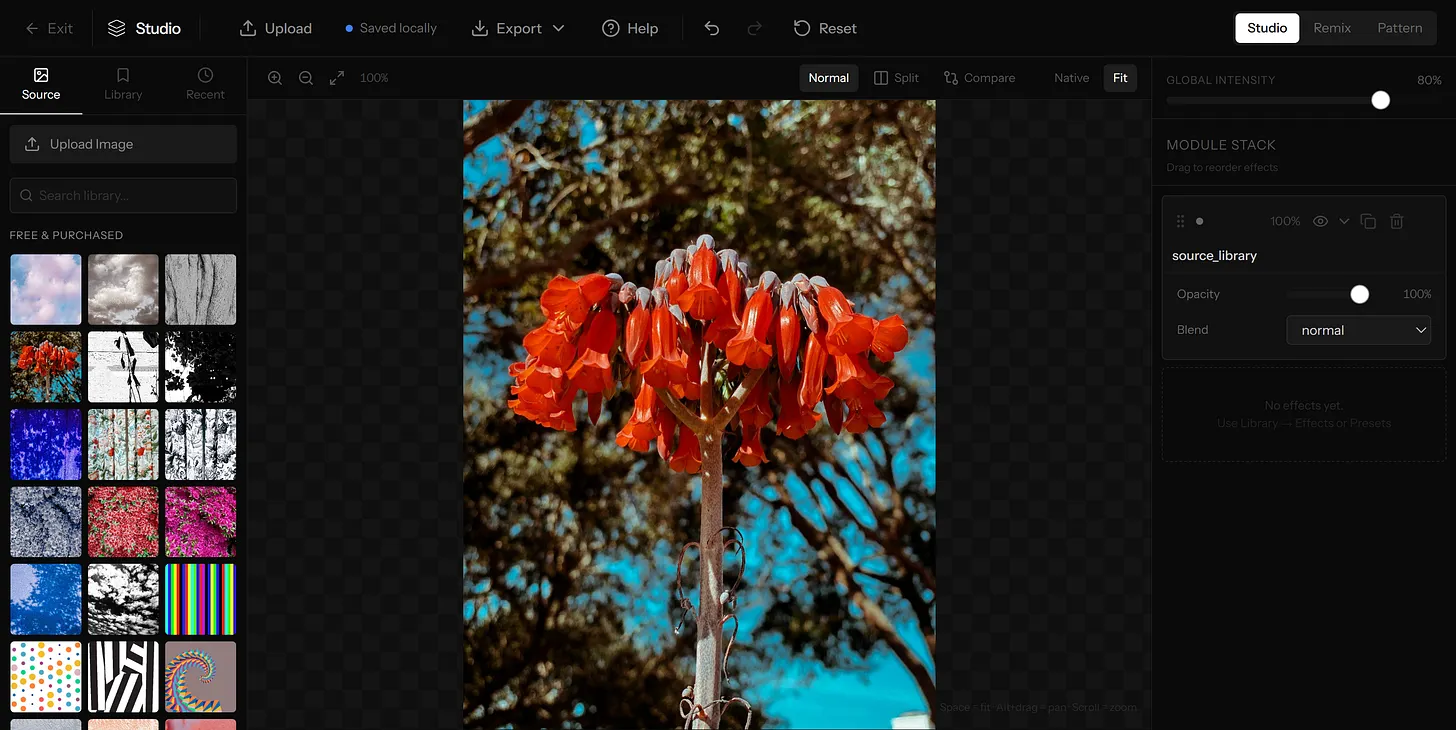
The Studio
Alongside the collection sits the studio.
It is a browser-based workspace built as a non-destructive system in which images can be adjusted, extended, or combined without being fixed too early. Each transformation remains visible, part of a sequence rather than a single irreversible step.
The structure reflects a particular way of working. One that moves between direct composition and process. An image can be constructed deliberately, or it can arrive through a series of adjustments, where an effect, used with some precision, becomes structural rather than decorative.
The studio supports this without insisting on it.
Where the Work Begins
Much of the work now understood as physical begins elsewhere.
It begins on screen.
This is not a departure from art and design, but an extension of it. The computer is part of the studio, just as the press, the camera, or the drafting table once were. To treat the digital file as secondary, or as something that must be translated into legitimacy through physical form, is to misread how most contemporary work is made.
Visual Bounty does not separate these stages.
The file is not an approximation of the work.
It is the work.
What follows is a continuation.
From File to Object
When images move into production, the translation is direct.
The same image can be realized as a giclée print, a textile, or a surface, with attention to fidelity. How color holds, how material responds, how the image resolves at scale.
These are not treated as reproductions in a diminished sense, but as accurate physical expressions of a work that already exists.
Images produced in this way move into real environments. They are placed, installed, and lived with.
Movement
Images do not remain in one role.
Within the same environment, a work can be encountered as a finished piece, reconsidered as material, or extended into something else. A composition, a pattern, a surface. The transitions between these states are not treated as separate tasks, but as part of a continuous process.
There is no requirement to transform, only the possibility.
Distribution
The system does not end at production.
Work can move into retail and wholesale channels, as well as direct e-commerce environments. The same image can exist as a file, as a print, and as a product, without needing to be restructured for each context.
A Practical View
The system is shaped by the conditions of the present.
Creative work is distributed across many places, while production and logistics still introduce friction. Cost, distance, and time all play a role. At the same time, images are expected to function across contexts, from digital use to physical application.
Visual Bounty takes a steady view of this.
It allows work to move more directly from source to use, reducing the steps between where an image is created and where it is realized.
Closing
Visual Bounty is the result of an extended way of working.
It holds that some images should remain as they are.
That others can be developed further.
And that both positions can exist within the same environment without conflict.
The system does not resolve that distinction.
It makes room for it.
Launch
Visual Bounty is now live.
It has been developed over several iterations and reflects an ongoing way of working. The collection, studio, and production system are all in place and will continue to expand.
You can explore the library, work within the studio, and produce or order work directly through the platform.