An online store is often described as a website where people browse products and place orders. For the business operating it, the storefront is only one part of a much larger environment.
A product begins long before it appears on a page. It has a design, a name, a set of specifications, images, production requirements, pricing, and a place within a collection. Once published, that same product needs descriptions, search information, marketing materials, customer communication, fulfillment arrangements, and a record of how it performs. When a business works across hundreds or thousands of designs, the relationships between these activities become as important as the activities themselves.
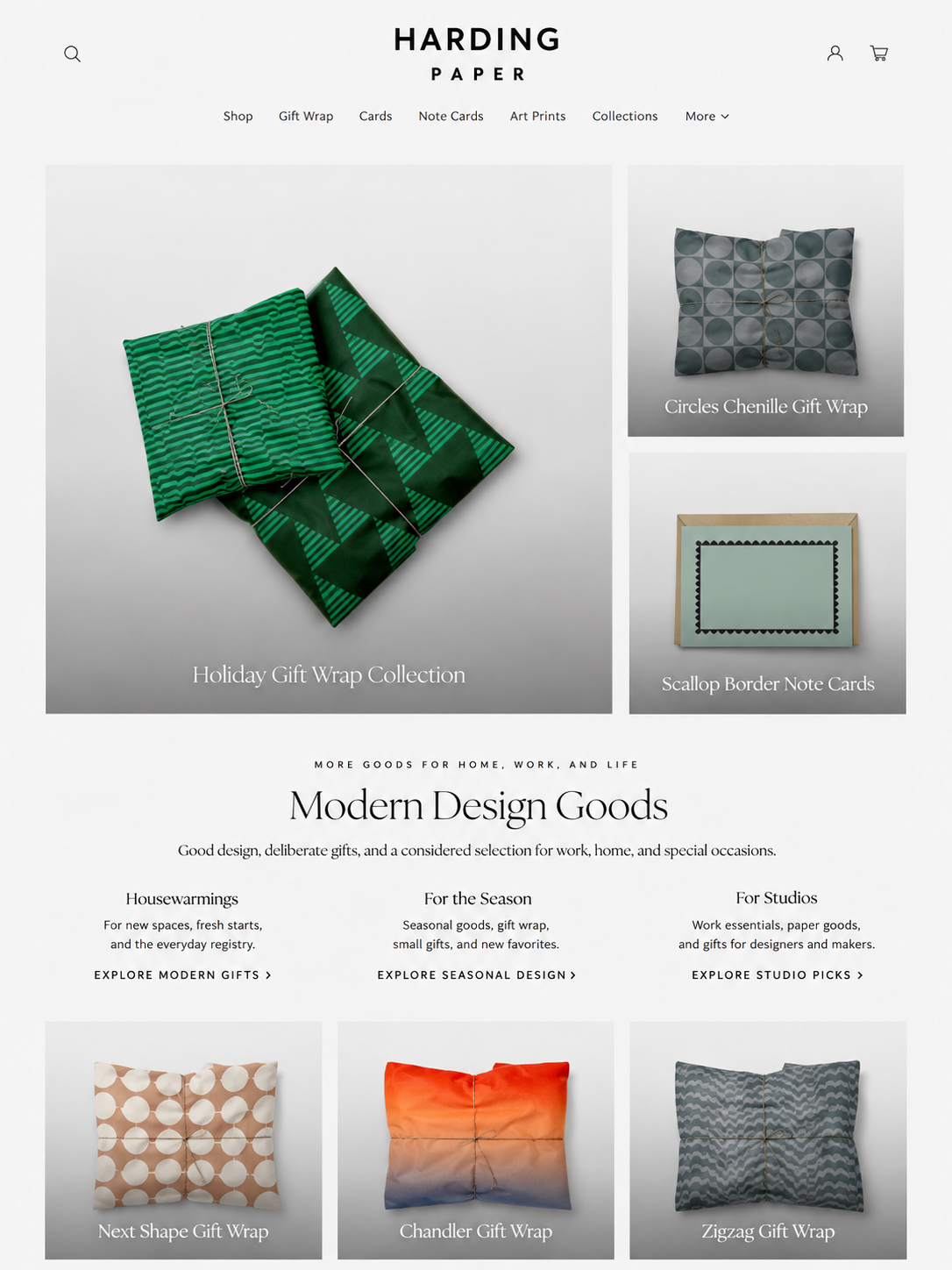
This is the perspective behind Harding Paper, a design-led goods business and an ongoing working example of how Crafted Tools approaches connected ecommerce systems.
A product is more than a listing
Harding Paper's catalog grows from an extensive body of original surface designs. A design may have different applications, product formats, images, materials, and presentation requirements. Those relationships need to remain intelligible as the assortment grows.
In a conventional workflow, product information is often copied between spreadsheets, ecommerce platforms, design files, production services, and marketing tools. Each copy creates another place for information to become inconsistent.
A connected catalog offers a different starting point: keep the important information about a design and its products organized, then use that information across the business. Product descriptions, specifications, imagery, collection assignments, and publication details can be managed as related parts of one system rather than as isolated tasks.
This is not only a matter of efficiency. The quality of a customer's experience depends on the accuracy and consistency of what the business presents.
Where AI assistance belongs
AI is useful in ecommerce when it supports specific, reviewable work.
An image and a small amount of verified product information can provide a starting point for a description, a set of relevant search terms, or accessible alternative text. Catalog records can be checked for missing fields, inconsistent naming, or information that needs attention. Existing material can be adapted for different channels without requiring the business to begin from a blank page every time.
Crafted Tools has explored one part of this process through Product Index, a tool for preparing product listing content from images. Harding Paper offers a broader context for that capability: the listing is one output within a continuing commercial operation.
The distinction matters. An AI-generated description should not invent materials, dimensions, manufacturing methods, or other facts that a photograph cannot establish. Product data needs an authoritative source, and suggested content needs review before it becomes a customer-facing claim.
The aim is to reduce repetitive preparation while keeping product knowledge and editorial decisions under the business's control.
Connecting the work around the catalog
An ecommerce environment also includes what happens after a product is created.
Collections need to be assembled and presented. Campaigns need images and copy. Customers need clear information before and after purchase. Orders need to move through production and fulfillment. A business needs to understand what is selling, which products need attention, and where operational work is accumulating.
These activities are frequently handled by different services. A connected system does not necessarily replace them all. It gives the business a more coherent way to work across them, retaining the relationships between products, content, orders, and decisions.
That may involve integrations with established commerce, production, communication, and analytics services. It may also involve purpose-built tools for tasks that a standard ecommerce platform does not address particularly well.
The right configuration depends on how the business actually operates.
A design business as a working environment
Harding Paper is useful to Crafted Tools because it is not a fictional demonstration catalog. It is a business with original designs, product presentation requirements, and the everyday operational questions that accompany selling physical goods.
It also reflects a design perspective. Typography, imagery, product organization, packaging, and the customer's experience are not separate from the system behind the store. They are among the ways that system becomes visible.
Working with a real catalog makes it possible to investigate where structured information helps, where automation is appropriate, and where human judgment remains essential. The business can be used to develop and refine repeatable methods without assuming that every client needs the same implementation.
What this means for other ecommerce businesses
A connected ecommerce system might begin with a product catalog that needs better organization. Another business may need a reliable way to prepare listings across several sales channels. A third may need to connect production partners, customer communication, and internal operations.
Crafted Tools approaches these as related but distinct problems. The work begins with the products, the people responsible for them, the existing services, and the decisions that need to move between those services.
AI augmentation can then be introduced where it makes a practical difference: assisting with content, identifying missing information, supporting review, and helping teams act on reliable records.
The larger opportunity is not to automate an entire business indiscriminately. It is to make the business easier to understand, manage, and extend.
Harding Paper provides a continuing example of that approach, connecting the design of the products with the design of the systems that support them.
Explore Harding Paper and Crafted Tools.